Youth's Lives Every Day
Content Warning: This story explores eating disorders. For support, our trained crisis counselors are available 24/7 at 1-866-488-7386, via chat www.TheTrevorProject.org/Get-Help, or by texting START to 678-678.
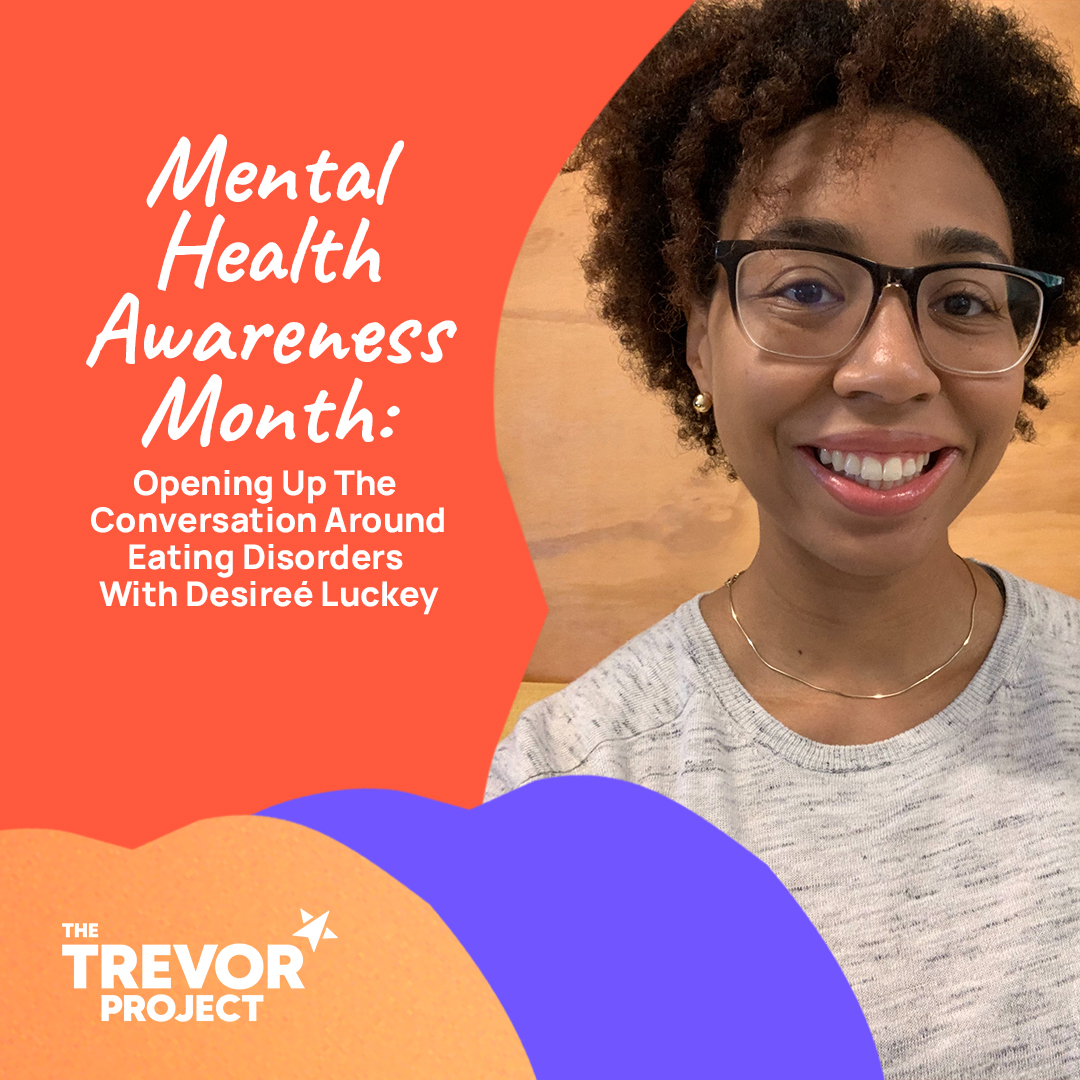
This Mental Health Awareness Month, The Trevor Project is challenging norms and facilitating honest discussion around the real issues LGBTQ young folks deal with. Desireé Luckey, Director of Policy at URGE: Unite for Reproductive & Gender Equity, sat down with The Trevor Project to open up the conversation around eating disorders in the LGBTQ community and discuss the implications of recent research released by The Trevor Project on eating disorders among LGBTQ youth.
From a young age, Desireé felt that eating disorders were presented as something only “skinny, cisgender white girls” dealt with. But Desireé, a Black queer woman who survived an eating disorder in her adolescence and early adulthood, is able to see the issue as far more complex than that: “There’s been a lot of unlearning for me to get to a point where I can say this is not some experience that is exclusive to me and white women. This is something a lot of people deal with, and we need to have some more honest conversations about it so we can find better solutions for queer folks, folks who aren’t white, and folks who aren’t affluent.”
For marginalized LGBTQ young people, the course to eating disorder diagnosis has many roadblocks: “You could suspect something is going on and not know exactly where to find resources, or feel like because of who you are, this couldn’t possibly be something you’re dealing with. There’s probably a large number of people who haven’t suspected they have an eating disorder, but actually do,” Desireé explained. The Trevor Project’s research reveals a startling disparity — Black LGBTQ youth reported comparable rates of suspecting they have an eating disorder to White LGBTQ youth, despite White LGBTQ youth being diagnosed at more than twice the rate of Black LGBTQ youth.
Desireé shared, “A lot of the time, in the Black community, eating disorders are just not discussed. The dissonance that Black people and people of color experience with eating disorders is really damaging, so it’s really important to understand that [disordered eating] affects folks across all communities, and really disproportionately affects low income Black people. Those are also folks who are less likely, for health equity reasons, to be able to access any health care, let alone specialized programs or services for eating disorders.”
She continued: “People in our communities are going to keep suffering for lack of attention, resources, and knowledge, but it doesn’t have to be that way. For advocacy organizations and service providers to do more outreach to communities of color, LGBTQ folks, and folks outside of the traditional idea of people who have eating disorders is really important. I’m hopeful that organizations that focus on prevention and recovery can do more to prioritize the communities most in need of service.”
For Desireé, addressing and changing these disparities also means normalizing discussion around eating disorders in communities of color and queer communities. “I think most people would be surprised how many people around them are actually dealing with eating disorders because it’s still so stigmatized to talk about. The more people share their stories and experiences, the more we have these conversations in authentic ways, the better it is for all of us.”
If you are an LGBTQ young person struggling with an eating disorder, or you know someone who is, don’t hesitate to reach out to The Trevor Project or the National Eating Disorders Association (NEDA) for support.
Sue Cardenas-Soto is a Copywriter at The Trevor Project, the world’s largest suicide prevention and mental health organization for lesbian, gay, bisexual, transgender, queer & questioning (LGBTQ) young people. If you or someone you know is feeling hopeless or suicidal, our trained crisis counselors are available 24/7 at 1-866-488-7386 via chat www.TheTrevorProject.org/Get-Help, or by texting START to 678-678.

